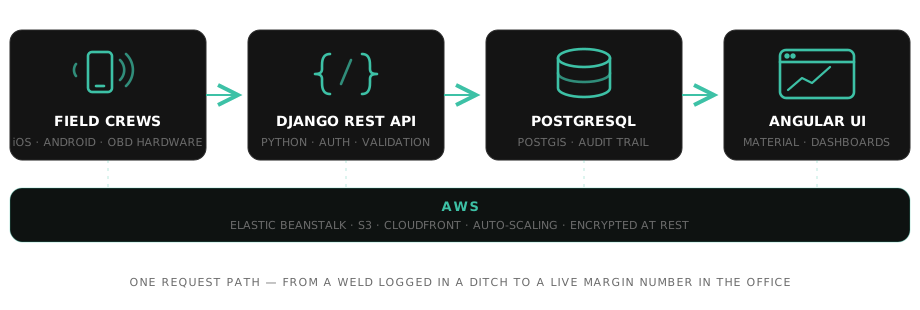
Python, Django REST, PostgreSQL on Amazon RDS, Angular with Material, and AWS Elastic Beanstalk: a battle-tested, scalable foundation purpose-built for the demands of pipeline operations, integrity management, and regulatory compliance.
Each layer was chosen for the same reason: it holds up under industrial-grade workloads and the weight of long-term maintenance.
The lingua franca of data science, automation, and engineering. Python's vast ecosystem for geospatial analysis, time-series processing, and machine learning is unmatched, perfect for pipeline integrity calculations, leak detection models, and predictive maintenance.
A mature, secure, batteries-included framework that handles authentication, permissions, ORM, migrations, and admin tooling out of the box. Django REST Framework delivers production-grade APIs with serializers, viewsets, and granular permission classes, critical for multi-tenant SaaS.
The most capable open-source relational database on the planet, running on Amazon RDS in AWS: automated backups, Multi-AZ failover, and point-in-time recovery, fully managed. PostGIS extensions make it the gold standard for storing pipeline geometries, well locations, and route data. ACID compliance, JSONB, and time-series capabilities cover every operational data need.
An opinionated, enterprise-grade frontend framework with TypeScript safety, dependency injection, and a powerful CLI. Angular Material provides accessible, consistent UI components, letting your team ship polished dashboards, forms, and reporting tools fast.
A managed deployment platform that gives you AWS power without DevOps overhead. Auto-scaling, load balancing, health monitoring, rolling deployments, and tight integration with RDS, S3, and CloudWatch, all behind a few configuration files.
Oil & gas pipeline software has unique demands: regulated, geospatial, audit-heavy, mission-critical, and built to last decades. This stack hits every requirement.
Pipelines are inherently spatial. PostgreSQL with PostGIS is the most capable geospatial database available, supporting everything from pipeline centerlines and right-of-way polygons to high-consequence area overlays.
PHMSA, API 1163, API 1173, and state-level reporting all demand traceable, auditable data. Django's ORM, migrations, and built-in admin combined with PostgreSQL's transactional integrity make every change traceable. Role-based access satisfies SOC 2 and operator audits.
Pipeline operations generate enormous time-series volumes from SCADA, ILI runs, cathodic protection surveys, and inspection data. Python's data ecosystem (Pandas, NumPy, scikit-learn) plus PostgreSQL's partitioning and indexing handle billions of rows.
Pipeline operators need dense, data-rich interfaces, not consumer-style minimalism. Angular's structure scales past 50,000 lines, and Angular Material gives you accessible, consistent components. TypeScript catches bugs before they ship.
Python, Django, Angular, and PostgreSQL are all widely-known. You won't be hunting unicorns to maintain or extend your platform five years from now.
Clean separation between the Django REST backend and the Angular frontend means each side evolves independently. The API can serve mobile field apps, partner integrations, and reporting tools.
No proprietary database licensing. No locked-in framework fees. Predictable release cycles and long-term support paths. Cost structure stays sane at scale.
Django CSRF protection, SQL injection prevention, secure password hashing. Angular template sanitization. PostgreSQL row-level security. AWS encryption, IAM, VPCs, and compliance certifications including FedRAMP.
From integrity management to one-call ticketing, the stack covers the actual workloads pipeline operators run every day.

Store and analyze ILI runs, dig results, anomaly logs, and corrosion growth models. Run repair prioritization through Python ML pipelines.

Render pipeline centerlines, valves, HCAs, and class locations on interactive maps with PostGIS-backed spatial queries.

Generate PHMSA Annual Reports, leak reports, and operator qualification records straight from authoritative system data.

Track rectifier readings, test station surveys, and CP effectiveness over time with time-series storage and trend analysis.

Ingest 811 tickets, route them by location, track responses, and close the loop with mobile-friendly Angular field tools.

Track every weld, valve, fitting, and component from manufacture through installation, inspection, repair, and retirement.
Elastic Beanstalk is the sweet spot for Pipeline SaaS: more managed than raw EC2, less restrictive than a fully serverless platform. It runs the Django application on EC2 behind an Application Load Balancer, handles Auto Scaling, and orchestrates rolling, immutable, or blue/green deployments, all from configuration files committed to the repository.
For a regulated, mission-critical industry, this combination delivers enterprise reliability without forcing the team to become full-time DevOps engineers, letting them stay focused on pipeline domain logic where the real value lives.
The same qualities that make a pipeline last 50 years apply to the software running it.